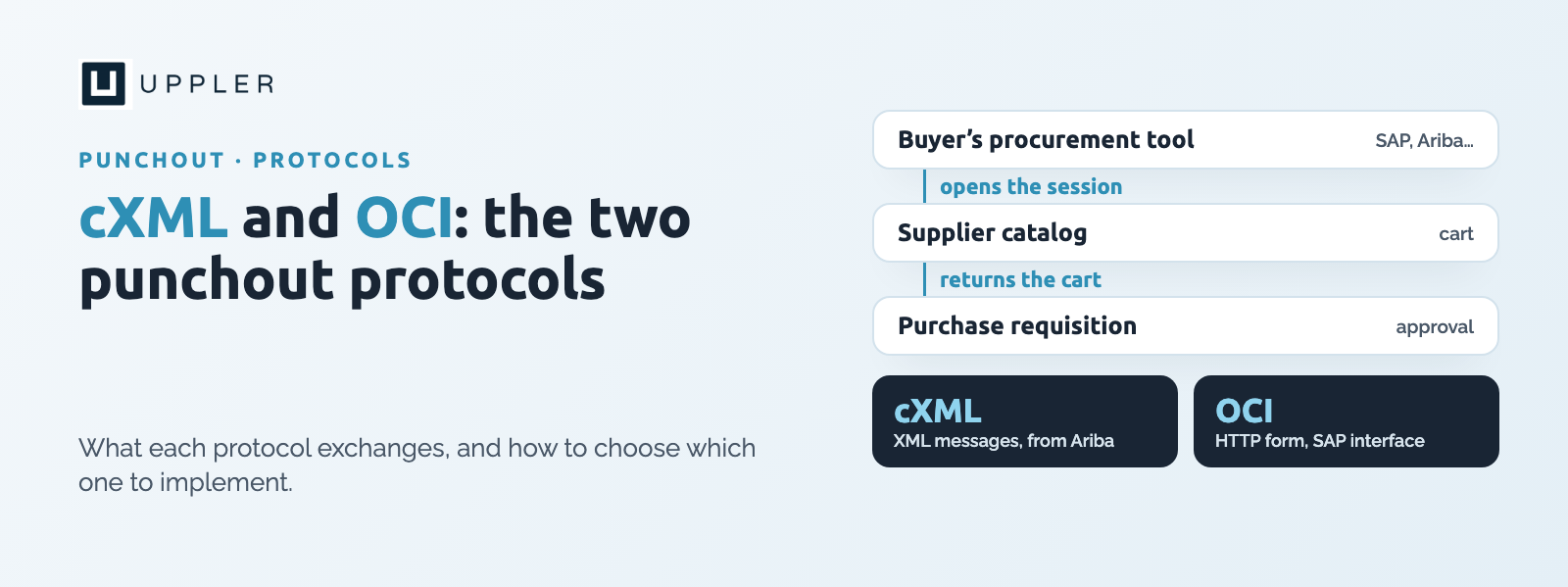
In a laboratory, a hospital or a university, consumables are almost never ordered from a supplier’s website. The order starts in the institution’s purchasing tool, where the contract, the budget and the approval flow are already set up. For a supplier of research or healthcare products, being present in that tool means being ordered.
Punchout is the connection that makes this presence possible: the buyer opens the supplier’s catalog from their own tool, fills a cart, then sends it back for approval. We have already explained how it works and its two protocols. This article looks at one specific case, buyers in healthcare and research, whose requirements change what a punchout catalog must contain.
The sector-specific points below rely on sources from suppliers and service providers in the field, listed at the end of the article. They describe common practices, not a rule.
Universities, hospitals, biotechnology companies and pharmaceutical laboratories buy a lot through e-procurement systems, according to IWD Agency, an agency that supports laboratory suppliers with their online commerce. The reasons are those of any organized purchase: a contract, a budget, an approval chain.
In a large institution, hundreds of laboratories may buy under the same contract. The institution therefore tries to route every order through a single channel, which applies the negotiated prices and makes it possible to track spending. A supplier that is not in that channel forces each team to leave it to place an order. For the general framework of these purchases, see our article on taking back control of your indirect purchasing.
A laboratory regularly reorders the same items. Punchout avoids re-entering a cart in the purchasing tool and reduces the risk of errors on the item or the quantity. Some suppliers even publish a page dedicated to e-procurement purchases, such as STEMCELL Technologies, where the cart is transferred into the buyer’s system.
A punchout catalog is not a copy of the online store: it is the store, seen from the buyer’s tool, with the conditions of their institution. The common definition is that of a live link between the buyer’s purchasing system and the supplier’s hosted catalog (CASRAI); our definitions also appear in the B2B procurement glossary, and the general principle in Punch Out: what is it and why adopt it?. For healthcare and research, four points keep coming up.
For regulated and research products, documents are not an extra. The buyer often needs the safety data sheet and the certificate of analysis before approving the purchase, according to IWD Agency. The certificate of analysis is tied to the batch, ideally searchable by batch number, and the safety sheet is downloaded from the product page. In a punchout session, these documents must therefore stay accessible from the catalog, as in the usual online store.
In the session, the buyer builds their cart with their negotiated prices. The cart price must then match the purchase order and the invoice. A gap triggers a manual check, which is exactly what the connection is meant to avoid.
Each customer’s purchasing system asks for its own identifiers and its own pricing, and sometimes a subset of the catalog. On the supplier side, this means managing conditions customer by customer, not a single catalog for everyone.
Source: summary of the practices described by IWD Agency.
The institution’s purchasing system generally speaks cXML or OCI, according to IWD Agency. The supplier has no choice: a supplier serving several institutions often handles both. Our article on cXML and OCI details what each one requires.
Each implementation on the buyer’s side has its own particularities. Plan testing time with each customer’s purchasing team. The first connection serves as a model for the next ones, but it does not remove the need to test them.
Punchout serves institutions that buy through their purchasing tool. Other customers, new accounts and direct orders keep going through the usual online store, which must stay up to date. This is also why the punchout catalog and the store catalog must share a single source, otherwise prices and stock levels drift apart.
Punchout connects one supplier to one institution. It does not solve everything. ZAGENO, a vendor of a multi-supplier laboratory purchasing platform, notes in a 2026 article that many niche suppliers do not offer punchout, which forces buyers into workarounds and increases off-channel purchases. It adds that each supplier requires its own integration, testing and maintenance, and that punchout was not designed to steer sourcing across dozens or hundreds of suppliers.
This view comes from a player that defends a different approach, and should be read as such. It still points to a real limit. For a supplier, punchout opens the accounts that buy through e-procurement, but it replaces neither presence in other channels nor the handling of off-catalog products.
This is where the marketplace complements punchout. It can serve as a single entry point: the buyer connects once and finds several sellers behind the same connection. We described it in Punchout: how it works and what it means for suppliers; the same catalog challenge appears on the marketplace side, with seller catalog integration.
Uppler handles punchout connections to Ariba, Coupa, Ivalua and Procurify, manages customer-specific pricing and B2B payment terms, and can connect punchout to a marketplace that serves as a single entry point. Ozyme, an Uppler customer and a distributor in healthcare and research, serves buyers who require it through punchout.
For a supplier in this sector, the first step is to list the customers that buy through a purchasing tool, and each one’s protocol. The e-procurement platform page presents the approach, and the pharmaceutical industry page shows how this sector is served.
This work is part of a broader effort to deploy a purchasing tool, which we cover in our guide Déployer l’e-procurement en 2027 (in French). To discuss your catalog, request a demo.
It is a live connection between a buyer’s purchasing system and a supplier’s hosted catalog. The buyer fills their cart on the supplier’s site from their own tool, then the cart returns to the tool for approval.
Because they buy through a purchasing tool where the contract, the budget and the approval flow are set up. Punchout avoids re-entering carts and applies the negotiated prices.
According to sector sources, the buyer often needs the safety data sheet and the certificate of analysis before approving a purchase. The certificate is tied to the batch, and the sheet is downloaded from the product page.
The choice is the buyer’s, depending on their purchasing tool. A supplier serving several institutions often handles both protocols.
No. It serves institutions that buy through their purchasing tool. Other customers and direct orders keep going through the store.
Punchout covers them poorly: many small suppliers do not offer it. A marketplace can serve as a common entry point, with several sellers behind a single connection.
It depends on the customer: each implementation has its own particularities and requires testing time with the purchasing team. It is counted in weeks.
1-month launch with our all-in-one solution
Specialized in B2B e-commerce
Integration team to make your project easier

Morgan Clark
Platform manager at Label Corner
"Customer service is highly responsive and the plateform is easy to use.
The solution has a great adaptability, great value for money and enables a fast implementation"