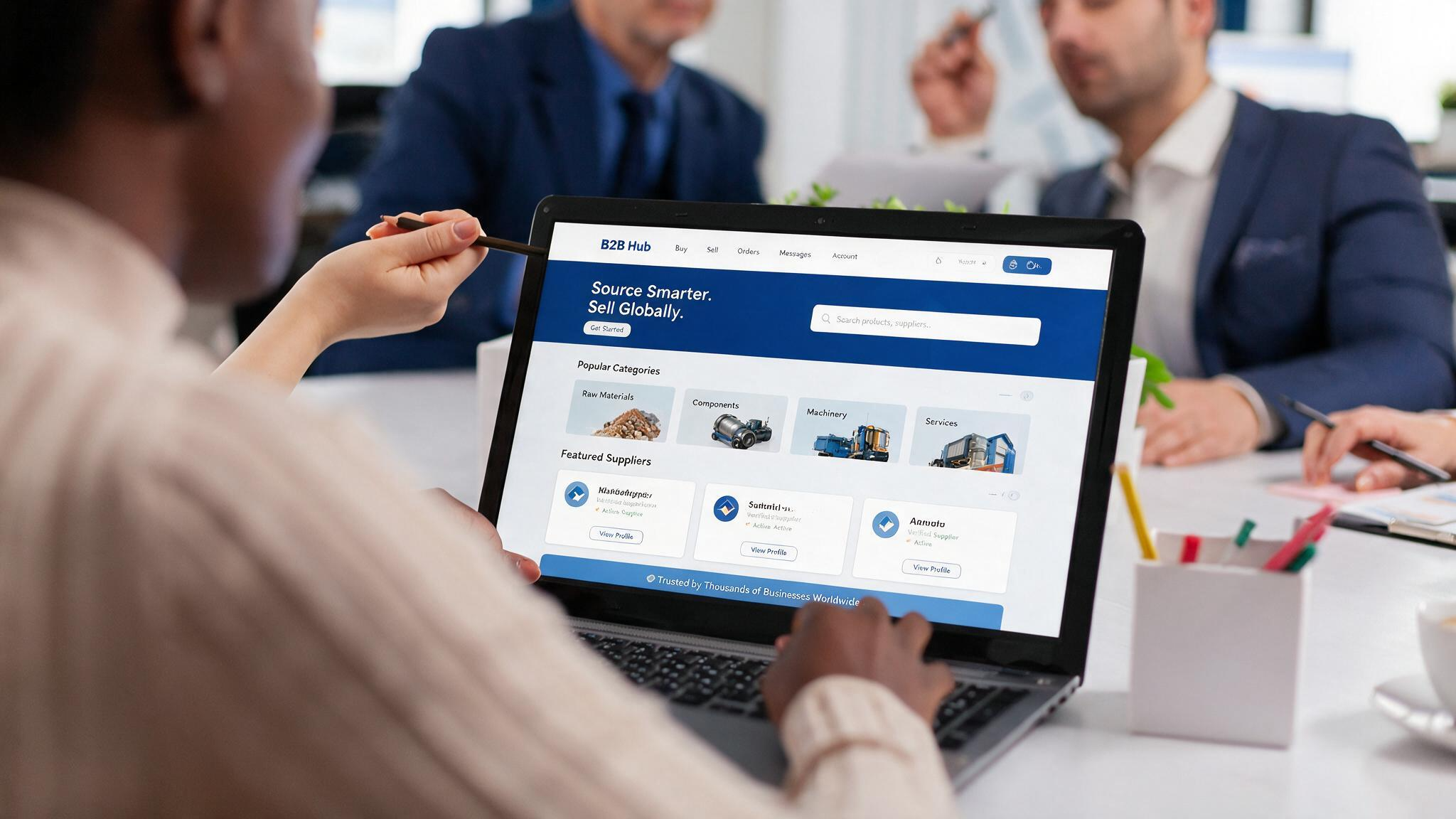
Punchout is the connection that lets a business buyer browse their supplier’s catalog from inside their own procurement system, then send their cart back to that system for approval. The supplier stays on its own site, with its own prices and real stock levels. The buyer keeps control of their ordering process. This mechanism has become a prerequisite for selling to accounts that buy through e-procurement.
This guide is for B2B suppliers and distributors who are hearing about punchout for the first time, or who need to respond to a request from one of their customers. It explains how the mechanism works, what buyers expect from it, what the protocols require and what the supplier has to sustain over time.
The question often comes up as a technical constraint. It deserves to be framed first as a commercial one. A customer asking for punchout is telling you they want to keep buying from you, provided it goes through their own process. The question also applies to distributors running their own B2B marketplace, as we will see below.
The term refers to a connection between two environments. The buyer leaves their procurement system to visit the supplier’s store, then returns to it with their cart.
The buyer’s system, known as an e-procurement platform, handles purchase requests, approval workflows and purchase orders. The supplier’s system is its online store, with its catalog, prices and inventory. Punchout links the two without merging them.
The buyer does not log in to the store like an ordinary visitor. Their identity, company and pricing terms are passed along from the moment they arrive. They see the offer reserved for them.
It is not a hosted catalog. With a hosted catalog, the supplier sends a product file to the buyer, who imports it into their system. The file starts going stale the moment it is uploaded. Prices change, stock moves, part numbers get replaced.
Punchout solves this problem by fetching information at the source. The catalog stays with the supplier, and the buyer browses it in real time.
A punchout catalog is the supplier’s store as the buyer sees it from inside their procurement system: its offer, negotiated prices and available stock, all viewed live. It is the most common form of punchout ecommerce, which connects a supplier’s B2B online store to its customers’ purchasing tools.
The term was popularized by Ariba in the late 1990s. As Manutan’s documentation points out, the terminology was later adopted by the major procurement platforms, including Coupa, Ivalua and others. The term stuck, and is written punchout, punch-out or punch out.
The mechanism is easiest to understand by following an order from start to finish. It happens in three stages, from the buyer’s login to the issuing of the purchase order.
The buyer logs in to their e-procurement platform, selects an approved supplier and launches the connection. Their credentials are verified, then they are redirected to the supplier’s store. They browse with their negotiated prices, authorized products and available stock.
When the buyer is done, they do not check out on the store. They send their cart back to their procurement system, which creates a purchase requisition that follows the company’s internal approval workflow.
The requisition is approved according to the buyer’s rules, then converted into a purchase order. The purchase order is sent to the supplier for fulfillment. The store was used for selection; the buyer’s system kept control over authorization.
This is precisely where punchout differs from a standard online sale. The supplier does not decide when the order becomes firm. The buyer does, within their own system.
The request almost never comes from the supplier. It comes from a purchasing department that wants to tie its spending to its existing process.
A company that rolls out an e-procurement platform does so to know who buys what, from whom, and against which budget. A supplier selling by phone, by email or through an unconnected store escapes that control. Punchout brings the order back into the official workflow.
Without a connection, an order placed on an online store has to be re-entered into the buyer’s system, or keyed in manually by the purchasing team. Product codes differ, prices change, errors pile up. Punchout removes this step by transmitting the cart directly.
Punchout is particularly well suited to low unit value, high variety purchases, known as class C or indirect purchases. Manutan notes that this category combines tens of thousands of items with low purchase frequency. A dynamic catalog spares the purchasing team from managing that volume by hand.
Under the mechanism sit two exchange formats. They are not interchangeable, and the supplier does not always choose which one to implement.
cXML is a communication protocol between procurement applications, commerce platforms and suppliers. The documentation published by cXML.org, maintained by SAP Ariba, describes it as a lightweight format designed to exchange business documents consistently. It has become the reference format for SAP Ariba, Coupa, Jaggaer and Oracle Procurement.
OCI, short for Open Catalog Interface, is SAP’s legacy interface. It relies on URL parameters and HTML forms, whereas cXML relies on structured messages. It remains present in SAP SRM and SAP S/4HANA environments. SAP therefore sits on both sides: SAP Ariba, its cloud procurement platform, uses cXML, while legacy SAP ERPs rely on OCI.
Gatebold sums it up: suppliers rarely choose between the two formats; the buyer imposes theirs. A supplier serving several key accounts must therefore be able to speak cXML for some and OCI for others. A ready-made connector handles this diversity; a custom build carries it for the entire life of the project.
The mechanism is a constraint as long as it remains an isolated request. It becomes an advantage once it covers a significant share of the customer portfolio.
A supplier that opens a punchout gains three things. The buyer explores the real catalog rather than a frozen list of preloaded items, so new products and complementary items stay visible. Entry errors disappear, since order data arrives without re-keying. Accounts that already buy through e-procurement become reachable without workarounds.
These effects are measured on the share of the portfolio concerned. A supplier serving ten key accounts, six of which buy through e-procurement, only reaches those six.
A buyer who has plugged a supplier into their procurement system does not switch over a marginal price difference. The connection, the price list setup and the order history create a real switching cost. The supplier that made the effort to connect is better placed at renewal time.
The returned cart contains the items ordered, quantities, negotiated prices and delivery terms. The supplier’s logistics team processes a clean order, with no clarification calls. The gain is modest per order, and becomes significant at volume.
The visible part is the store. The real work lies in what the store has to deliver on.
The buyer buys what they see, when they see it. An item shown as in stock but unavailable, or an outdated price, triggers a dispute as soon as the order is placed. The catalog must be the single source of truth, fed by real inventory.
This is more demanding than it looks. Supplier catalogs change fast, prices move, items get replaced. TradeCentric notes that aligning data between the two systems is one of the most frequent friction points during integration.
A connected buyer expects to find their negotiated prices, contractual discounts and delivery terms. This is configured per customer, which means the platform must be able to apply a different price list depending on the buyer.
A punchout integration is not set up once and for all. Protocols evolve, procurement platforms release new versions, data fields get realigned. The supplier must plan who maintains the connection, and how often.
The learning curve is real. Building, maintaining and evolving several punchout integrations requires skills that few in-house teams have from the outset. It is one of the reasons companies rely on a specialized platform.
A distributor that opens its site to third-party sellers becomes a marketplace operator. Punchout then raises an additional question. The buyer lands on a multi-vendor environment, while their procurement system expects one catalog and one contract.
Punchout connects to the marketplace, not to each seller individually. The buyer negotiates with the operator, browses the offer of several sellers and sends back a single cart. Pricing rules, delivery terms and spending limits are applied at marketplace level.
This is one of the operator’s roles: providing a single point of entry that respects its customers’ purchasing process.
The Uppler platform supports punchout connections to the main procurement platforms, including Ariba, Coupa, Ivalua and Procurify. It also handles customer-specific pricing, which applies negotiated terms to each connected buyer, as well as B2B payment terms, down payments and SEPA terms.
The platform also receives purchase requests, provides a purchasing dashboard and routes each order to the right seller. The buyer orders within their own process; the operator keeps control over the offer and invoicing.
Ozyme, a distributor in healthcare and research, relies on Uppler to serve, through punchout, the buyers who require it.
To find out which of your customers require punchout and which protocol they use, the Uppler team can review it with you during a demo.
It is a supplier’s store accessed from the customer’s procurement system, with negotiated prices and real-time stock. The buyer builds their cart there, then sends it back to their own tool for approval.
A hosted catalog relies on a product file imported into the buyer’s system. Punchout connects the buyer to the supplier’s store in real time. The latter avoids the obsolescence of the former.
No. The deciding factor is the buyer’s request. A small business selling to a group equipped with an e-procurement platform will need to provide punchout to remain an approved supplier. Supplier size does not settle the question; the buyer’s process raises it.
The one your customer uses. Most platforms rely on cXML, legacy SAP environments on OCI. A supplier serving several buyers must be able to cover both.
Initial setup takes a matter of weeks. The timeline depends on the number of buyers to connect, the quality of the starting catalog and the number of price lists to configure. Maintenance is an ongoing cost.
Access to accounts that buy through e-procurement, retention on recurring tenders and an end to manually re-keyed orders. A supplier that refuses punchout loses the buyers who require it.
1-month launch with our all-in-one solution
Specialized in B2B e-commerce
Integration team to make your project easier

Morgan Clark
Platform manager at Label Corner
"Customer service is highly responsive and the plateform is easy to use.
The solution has a great adaptability, great value for money and enables a fast implementation"