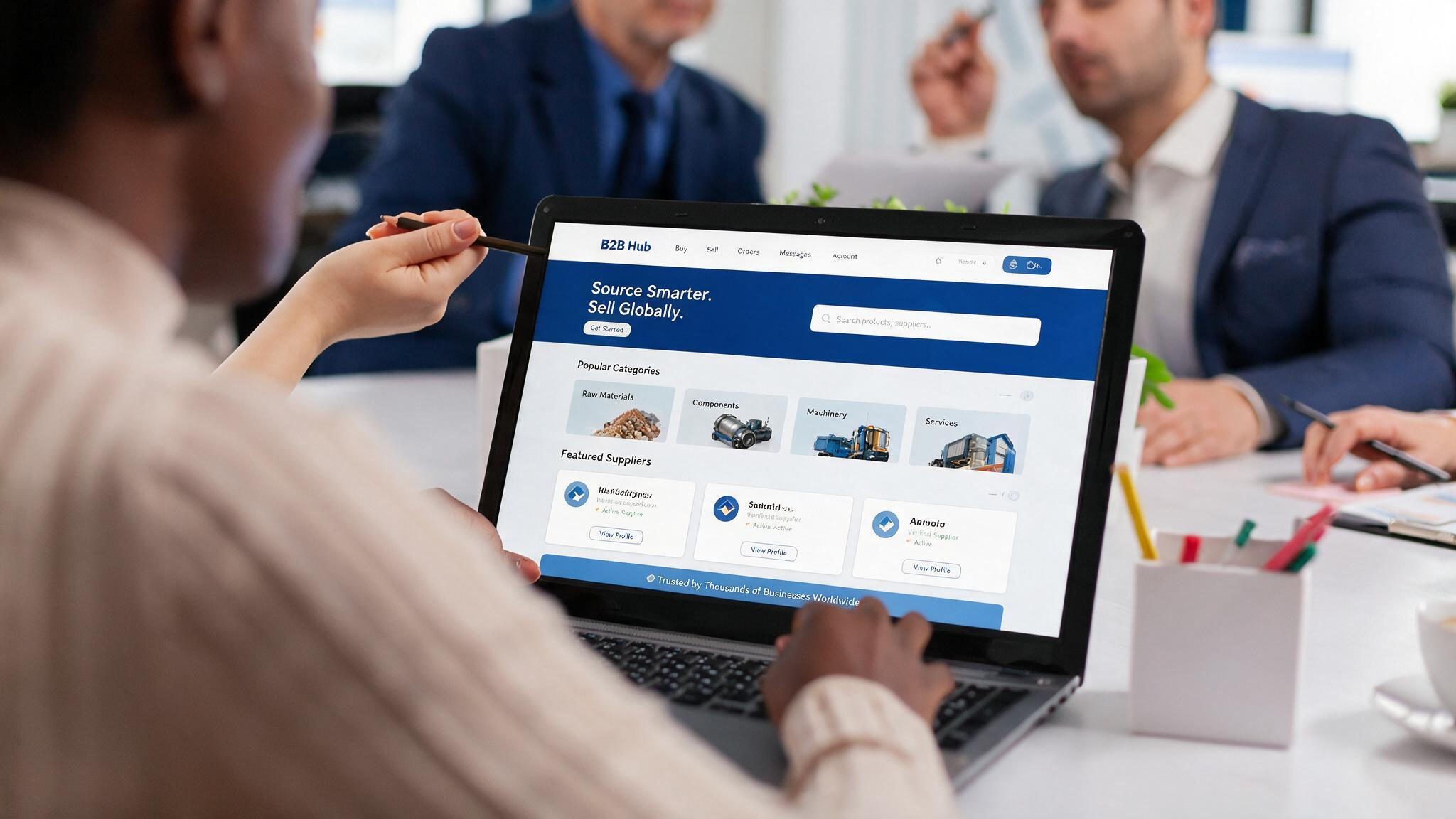
In an increasingly complex B2B environment, businesses are juggling a growing number of suppliers, rising order volumes, and mounting pressure for speed and transparency.
Yet many are still operating with disconnected systems: an ERP to manage internal operations, an e-procurement platform to handle purchasing, and a B2B marketplace to access new suppliers.
These organisational silos slow decision-making, fragment data, and limit strategic visibility. The challenge for senior leaders is clear: how do you build an integrated digital ecosystem that maximises operational efficiency and turns procurement into a genuine strategic lever?
The answer lies in model hybridisation: the orchestrated convergence of ERP, e-procurement, and marketplace into a single coherent system.
Each solution delivers value on its own, but in isolation, each hits its limits quickly:
The result: duplicated tasks, poor visibility across financial and operational flows, and friction between procurement, supply chain, and finance teams. For C-suite leaders, these silos represent a significant strategic drag.
Digital hybridisation means merging the flows, data, and processes from all three systems to create an integrated, agile ecosystem.
SaaS architecture has become the catalyst making this hybridisation possible. Where legacy, on-premise solutions limit interaction between ERP, e-procurement, and marketplace, cloud-based architectures now enable seamless interoperability across all three through open APIs.
Gartner estimates that over 85% of enterprise applications will be SaaS-based by 2025, a clear signal that flexibility and agility have moved from competitive advantage to baseline expectation.
In practice, SaaS integration allows a business to synchronise supplier catalogues in real time, automate order approvals, and instantly reconcile financial data from the ERP. According to McKinsey, organisations that have fully digitalised their procurement function report a 15 to 20% reduction in operational costs, alongside a significantly improved ability to respond to supply chain disruptions.
Beyond the technical architecture, hybridisation produces tangible strategic outcomes. For any senior leader, having access to unified, reliable data fundamentally changes how decisions get made. Where siloed systems force you to toggle between multiple tools and reconcile conflicting data, an integrated platform delivers consolidated, trustworthy KPIs in one place.
The result: faster, better-informed decisions, whether that means renegotiating a supplier contract or adjusting a production plan at short notice.
Agility improves as well. In a volatile supply chain environment, the ability to switch suppliers instantly, or to anticipate a demand spike using consolidated transactional data, becomes a decisive competitive advantage.
Forrester reinforces this point: B2B companies leveraging advanced ERP and marketplace integration report revenue growth 7% above the industry average.
This hybridisation is not just an IT project. It redefines how the organisation itself operates. Over time, the marketplace will become the central hub of the supplier network, continuously connected to both the ERP and e-procurement systems. Financial and logistics flows will no longer be processed in silos but orchestrated intelligently and automatically.
The B2B business of the future will function as an augmented digital network, capable of predicting its own needs, optimising procurement in real time, and securing supply chains through robust data governance. In this model, the role of leadership is no longer simply to manage costs. It is to transform procurement into a strategic lever for growth and resilience, giving the business a durable edge against disruption and an increasingly competitive landscape.
The hybridisation of B2B marketplace, e-procurement, and ERP represents a major strategic evolution. It goes well beyond a question of digital tooling: it fundamentally transforms how organisations manage their procurement, their supplier relationships, and ultimately their competitive position.
By bringing these components together in a coherent SaaS ecosystem, senior leaders gain unified data, greater visibility, and the agility to make decisions with confidence.
In a business environment where resilience and operational efficiency have become non-negotiable, hybridisation is emerging as the new standard for B2B operations, one that turns complexity into lasting competitive advantage.
Ready to build a sustainable marketplace and move to a hybrid model?
Let's talk about how to support the launch and growth of your marketplace.
1-month launch with our all-in-one solution
Specialized in B2B e-commerce
Integration team to make your project easier

Morgan Clark
Platform manager at Label Corner
"Customer service is highly responsive and the plateform is easy to use.
The solution has a great adaptability, great value for money and enables a fast implementation"