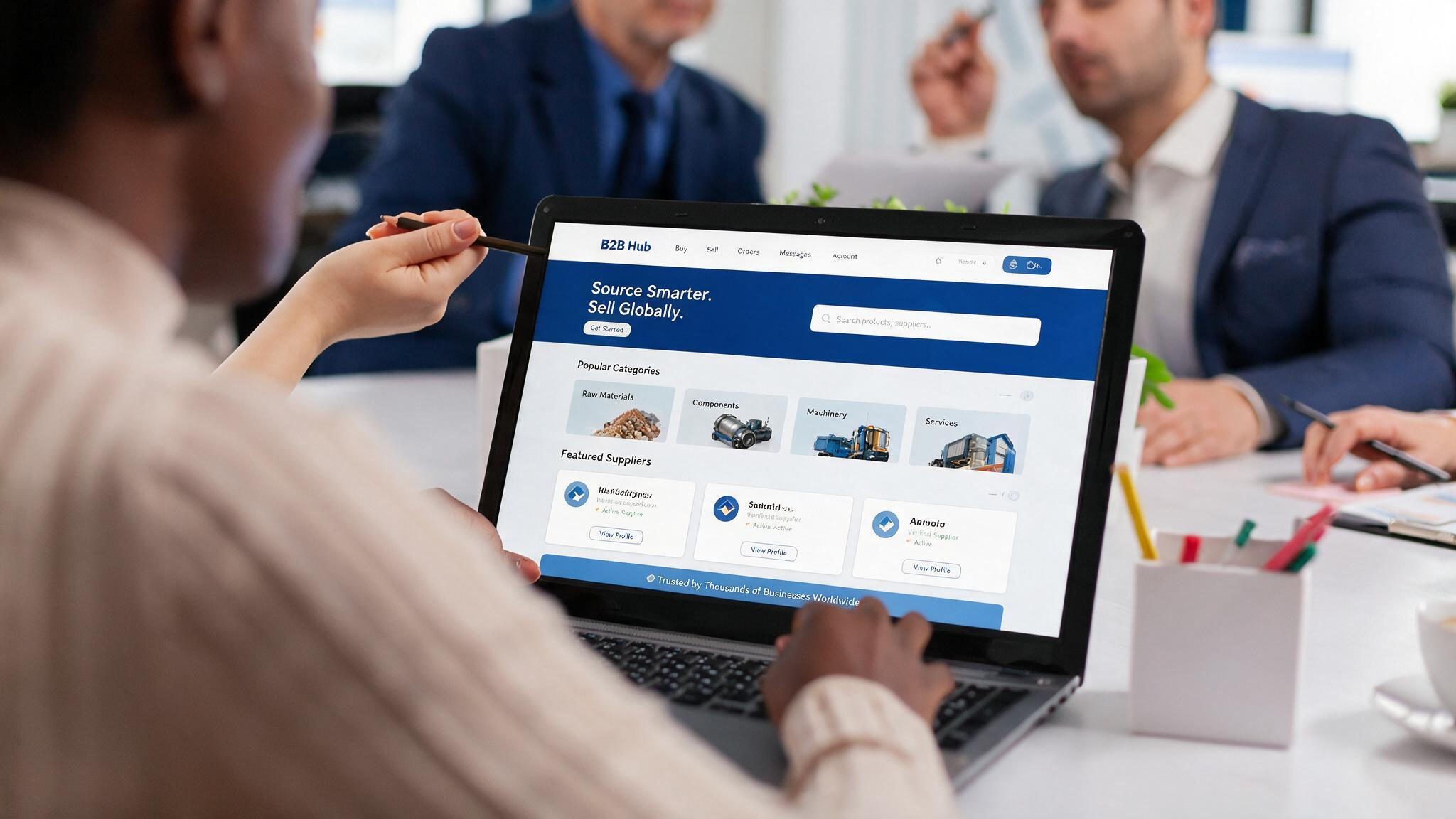
For a long time, the dominant model in B2B commerce was built on a direct relationship between supplier and customer.
The marketplace changes that dynamic entirely. It becomes an aggregator, a matchmaker, and sometimes a transactional intermediary sitting between the two.
This shift transforms the value chain and raises a critical question: how do you protect the customer relationship in an ecosystem where intermediaries are multiplying, and where the platform appears to be capturing the data, the experience, and the loyalty?
And more specifically: how do you benefit from what an aggregator offers without diluting your brand in the process?
When a marketplace becomes the dominant channel, it tends to concentrate three crucial elements:
The result: the supplier loses visible ground. The customer relationship shifts from "customer > supplier" to "customer > platform > supplier."
If this dynamic isn't actively managed, the business risks becoming little more than a product back-office, severing any meaningful connection between the customer and the brand.
This dynamic is especially relevant right now, as AI-powered interfaces like ChatGPT begin offering end-to-end purchasing journeys, from discovery through to payment, all within a single interface.
In B2B marketplaces, this three-way relationship is even more pronounced, given the length of sales cycles, the high expectations around service, and the central role that trust plays in supplier-customer relationships.
A survey on B2B marketplaces by TNP Consultants highlights that platforms must rethink both the customer journey and seller engagement to "enrich and personalise the relationship" rather than replace it.
In other words: the marketplace can help you put products in front of buyers, but the brand must retain ownership of the relationship over the long term.
As third-party cookies continue to disappear, B2B businesses are increasingly leaning on first-party data to understand, segment, and retain customers.
First-party data, collected directly through your own channels (website, CRM, support interactions, product usage) is more reliable, less exposed to external privacy constraints, and more accurately reflects real customer behaviour.
It also enables more precise attribution, understanding which actions actually led to a sale, which becomes fundamental when a marketplace is handling a significant part of the funnel.
Without that visibility, a brand is essentially selling blind on the aggregator: it no longer knows why a customer chose them, or which campaign or content actually made the difference.
This is why first-party data has become a non-negotiable asset, built on a foundation of trust and reliability.
In B2B, the customer relationship almost always extends beyond the transaction itself. It encompasses advice, ongoing support, after-sales service, and the ability to adapt to specific constraints.
When everything runs through the marketplace, those value-added services become optional extras or get standardised out of existence.
The supplier loses the very opportunity to create meaningful differentiation.
If your organisation is solely focused on acquisition, the following may shift your perspective: in B2B, acquiring a new customer almost always costs significantly more than keeping an existing one.
Research consistently shows that even modest improvements in repeat purchase rates can have a disproportionately large impact on profitability.
So if your customer relationship is "captured" by the marketplace, you're not just losing control of the experience. You're losing the long-term value of that customer entirely.
Customer Lifetime Value (CLV) is a central metric in any long-term strategy.
Knowing this, staying in control as the central aggregator and investing in loyalty isn't just good practice. It's a competitive imperative.
With the foundations established, here are the realistic approaches worth considering.
Rather than letting the marketplace interface completely take over, push for an integrated experience where your brand can:
This kind of coexistence gives the brand a visible presence throughout the customer journey, preserving identity without sacrificing the platform's technological capabilities.
Even when the transaction is orchestrated by the marketplace, you can maintain loyalty levers tied directly to your brand:
Research from Collinson shows that many loyalty programmes remain purely transactional (points, discounts) with little personalisation or depth of experience. That's a real opportunity for brands willing to go further.
Even within a marketplace environment, the user experience can remain a meaningful differentiator for your brand:
The goal: make the customer feel your brand, even within the aggregated environment.
There's no need to make a sudden, all-or-nothing shift. A measured strategy looks like this:
A hybrid logic works well here: the aggregator for long-tail volume, your own channels for strategic relationships.
Imagine a B2B business called TechFurnitures, selling specialist industrial equipment. They decide to join a sector-specific marketplace.
From day one, they negotiate to have their logo displayed, their product pages presented with their own visuals, and their brand identity carried through the UX.
The outcome: TechFurnitures captures the volume and new customer acquisition that the marketplace enables, without letting the platform own the relationship or erode brand equity. The best of both worlds.
That said, you won't always be able to shape the marketplace entirely on your terms. There are real constraints to acknowledge.
Moving to a marketplace model in B2B is not a sentence to losing control. On the contrary, it's an opportunity to reinvent the customer relationship on your own terms.
With a clear strategy, a consistent brand identity, smart data sharing, and a well-designed loyalty approach, a supplier can take full advantage of the aggregator model without sacrificing its identity or its relationship with customers.
The key is designing a model that is shared but supervised: the marketplace for reach and volume, the brand for the relationship.
Ready to build a sustainable B2B marketplace strategy?
1-month launch with our all-in-one solution
Specialized in B2B e-commerce
Integration team to make your project easier

Morgan Clark
Platform manager at Label Corner
"Customer service is highly responsive and the plateform is easy to use.
The solution has a great adaptability, great value for money and enables a fast implementation"