The query “B2B platform” is ambiguous, and it’s rarely just a matter of vocabulary.
It refers to two distinct objects that don’t serve the same role or the same decision-maker.
Confusing the two leads to choosing the wrong tool, then concluding that the platform doesn’t work.
The word “platform” has become commonplace. Any somewhat sophisticated B2B site presents itself as a platform, even though the models it refers to are different.
In this article, we distinguish two models:
One operates on the sell side, the other on the buy side. It’s this difference in role that makes it possible to determine the right solution.
We’ve already covered the choice between marketplace, e-commerce, and e-procurement from the angle of the role you play.
This article focuses on a specific point: when a project talks about a “B2B platform,” how do you identify the model it actually needs before choosing a tool?
You’re a distributor. Your catalog is solid, but it doesn’t cover everything your customers are looking for. You want to expand your assortment without carrying the stock of an entire sector yourself.
You then open your tool to third-party sellers who complement your offering. You’re no longer the only seller — you become the operator of a transaction venue where multiple parties meet.
That’s the B2B marketplace model. It relies on a network effect: more sellers attract buyers, and more buyers make the platform attractive to new sellers.
This model goes well beyond putting a catalog online. It requires in particular:
The marketplace is a powerful tool, and more demanding overall than a B2B site.
The promise justifies the effort. You become the gathering point of a sector, you capture the demand that your catalog alone can’t satisfy, you expand the offering without weighing down your stock. The decision-maker here is commercial or digital: the stakes revolve around the breadth of offering and demand capture.
This time, you’re on the buy side. You want to bring your suppliers, your reference catalogs, and your approval workflows together in a single tool.
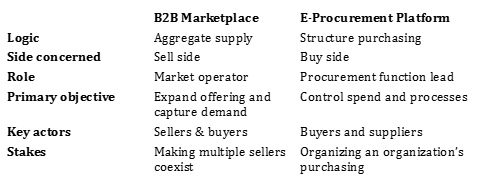
You’re not structuring a market’s supply — you’re structuring your organization’s demand. That’s the role of the e-procurement platform, which we’ve detailed for indirect purchasing. Where the marketplace aggregates sellers, e-procurement aggregates purchasing.
The work is therefore different. It requires in particular:
The promise revolves primarily around spend control, compliance, and visibility over purchasing.
The decision-maker is the procurement department, and their language isn’t that of the sales department.
2026 data confirms that this interlocutor carries weight. According to Forrester (The State of Business Buying, 2026), the procurement function is the decision-maker in 53% of B2B buying cycles, and it engages early in the process. A buyer with this clout isn’t looking for an open market — they’re looking for a tool that gives them visibility and control over their own flows. Offering them a marketplace means missing the need entirely.
Both models can share certain features: catalogs, orders, payments, or even integration with an ERP.
That’s precisely this overlap that can sustain the confusion.
To identify the right model, you need to start from the need rather than from the feature list.
Two questions settle it in practice.
The first
Are you looking to extend your offering toward your customers, or to structure your purchasing toward your suppliers?
The second
Are you a market operator, or a procurement function lead?
If your project consists of welcoming multiple sellers to expand your offering, you’re in a marketplace logic. If it consists of bringing your suppliers together and organizing your purchasing, you’re in an e-procurement logic.
The choice of technology comes next: it must respond to the role and the functioning of the project, not the other way around.
The electronic invoicing reform makes this distinction even more concrete. Electronic invoicing becomes mandatory in France starting September 1, 2026: on that same date, invoicing will become mandatory for large enterprises and mid-size companies (ETIs). SMEs and micro-enterprises will be subject to the invoicing obligation starting September 1, 2027.
This reform weighs differently on the two platforms.
Both must comply, but not in the same way, and not with the same flow architecture. Confusing the two as the deadline approaches means instrumentalizing a tool designed for the other role — and discovering too late that compliance is built on the right perimeter. The 2026 deadline forces you to name the platform you need, and you can still get started — contact us!
Before opening a software comparison, three steps help frame the project.
First, name the side. Are you selling to a market you want to expand, or are you structuring your organization’s purchasing? The question is about the role, not the tool, and it settles things before any demo. An answer on the sell side points toward the marketplace; an answer on the buy side, toward the e-procurement platform.
Next, project the electronic invoicing deadline onto your flows. How many billing flows will your tool need to handle by September 1, 2026? If the answer includes your own and those of your sellers, it’s a marketplace. If it’s limited to those of your suppliers on the buy side, it’s an e-procurement platform. The reform makes the flow perimeter concrete, and therefore the choice discernible.
Finally, compare your reading with the decision grid we’ve published. It distinguishes marketplace, e-commerce, and e-procurement across six concrete criteria, and it helps situate the choice within the broader landscape of B2B models. The role criterion is central there, because it drives all the others.
Still hesitating between marketplace and e-procurement? Talk to our team to identify the model suited to your project.
If your project consists of aggregating sellers around a market, our B2B marketplace platform is designed for that perimeter. If your project consists of structuring your purchasing, our e-procurement platform serves that role. And if you’re still hesitating between the two, request a demo tailored to your context.
A B2B marketplace aggregates sellers around a market: you’re the operator expanding the offering for your customers. An e-procurement platform structures an organization’s purchasing: you’re the buyer bringing your suppliers and flows together. One looks at the sell side, the other at the buy side. The features partly overlap, but the role and the decision-maker are not the same.
By naming the role before the tool. If you’re looking to expand your offering toward your customers by welcoming third-party sellers, it’s a marketplace. If you’re looking to structure your purchasing by bringing your suppliers and approval workflows together, it’s an e-procurement platform. The question is about the side — sell or buy — not about technology.
It can coexist with a purchasing logic, but the two objects don’t merge. A marketplace is built to aggregate the offering of multiple sellers; an e-procurement platform, to structure an organization’s demand. Forcing one toward the other role adds complexity without delivering on the original promise. The hybrid model exists, but it presupposes having first named both roles.
It makes it more concrete. A multi-seller marketplace manages multiple billing flows, with mandate logics and state-approved platform mechanisms. An e-procurement platform manages the receipt and circulation of invoices on the buyer’s side. The September 1, 2026 deadline forces you to decide which flow perimeter your tool must cover, and therefore which platform you need.
1-month launch with our all-in-one solution
Specialized in B2B e-commerce
Integration team to make your project easier

Morgan Clark
Platform manager at Label Corner
"Customer service is highly responsive and the plateform is easy to use.
The solution has a great adaptability, great value for money and enables a fast implementation"